When applying for a job, you may see employers asking for a CV or a resume. But what is the difference between CV and resume? Are they the same document, or do you need to prepare two different files?
A CV (Curriculum Vitae) and a resume both present your education, skills, qualifications, and professional background. However, they differ in length, purpose, level of detail, and how employers use them.
Understanding the difference between CV and resume can help you choose the right document for your job application. This is especially important if you are applying for international jobs in countries such as South Africa, Bangladesh, Canada, the UAE, the UK, or the USA.
In this guide, you will learn what a CV and resume are, their main differences, which one is better for your career, and how to choose the right format. You will also find practical examples to help you prepare your next job application.
What Is a CV (Curriculum Vitae)?
A CV, short for Curriculum Vitae, is a detailed document that presents your educational background, work experience, professional achievements, skills, and qualifications.
The Latin term Curriculum Vitae means “course of life.” A CV provides a broad overview of your academic and professional journey.
Unlike a short resume, a CV can include detailed information about your career history. It may also contain research projects, publications, professional memberships, awards, certifications, and academic achievements.
A CV is commonly used when applying for academic, research, teaching, medical, and certain professional positions. In many countries, including Bangladesh, South Africa, the UAE, and the UK, employers also commonly use the term CV for general job applications.
What Should a CV Include?
A professional CV usually contains the following sections:
- Personal Information: Your full name, phone number, professional email address, and location.
- Professional Summary: A short introduction explaining your qualifications, experience, and career goals.
- Work Experience: Previous jobs, internships, responsibilities, and achievements.
- Education: Your degrees, diplomas, institutions, and graduation dates.
- Skills: Relevant technical, communication, leadership, and professional skills.
- Certifications: Professional training, online courses, and relevant certificates.
- Projects and Research: Academic projects, research activities, or professional work.
- Awards and Achievements: Scholarships, academic awards, and professional recognition.
- Publications: Research papers, articles, books, or academic publications, when relevant.
- References: Include them when requested or when appropriate for the application.
You do not need to include every section. Choose the information that is relevant to the job you want.
Example of a CV
Imagine a person applying for a university lecturer position. Their CV might include:
- Name: Sarah Ahmed
- Education: Master of Business Administration
- Work Experience: Two years as a teaching assistant
- Research: Business management research project
- Publications: Two academic research papers
- Skills: Research, teaching, communication, and presentation
- Certifications: Advanced Excel and project management
This CV provides a detailed picture of Sarah’s academic qualifications and professional background.
What Is a Resume?
A resume is a short, professional document that highlights your relevant work experience, education, skills, and achievements.
Its main purpose is to show an employer why you are suitable for a particular job. Unlike a comprehensive academic CV, a resume is usually customized for each job application.
Most resumes are one or two pages long, depending on the applicant’s experience and the employer’s expectations.
Resumes are commonly used for job applications in the United States and Canada. Employers in other countries may also use the term, especially for international companies.
What Should a Resume Include?
A professional resume generally includes these sections:
- Contact Information: Your name, phone number, email address, and location.
- Professional Summary: A brief introduction highlighting your strongest qualifications.
- Work Experience: Relevant previous jobs and measurable achievements.
- Education: Your degrees, diplomas, and relevant qualifications.
- Skills: Technical and soft skills related to the advertised position.
- Certifications: Relevant professional certificates and training.
- Projects: Selected projects that demonstrate your abilities, especially if you are a fresher.
A resume should focus on information that helps you qualify for the specific job.
Example of a Resume
Imagine John is applying for a customer service representative position.
His resume might include:
- Name: John Smith
- Professional Summary: Customer-focused professional with two years of retail experience.
- Work Experience: Sales Assistant at ABC Store
- Key Achievement: Helped customers with product enquiries and handled daily sales transactions.
- Education: Diploma in Business Administration
- Skills: Customer service, communication, problem-solving, and Microsoft Office
John does not need to include every detail of his education or professional history. He should highlight the experience and skills that match the customer service position.
What Is the Difference Between CV and Resume?
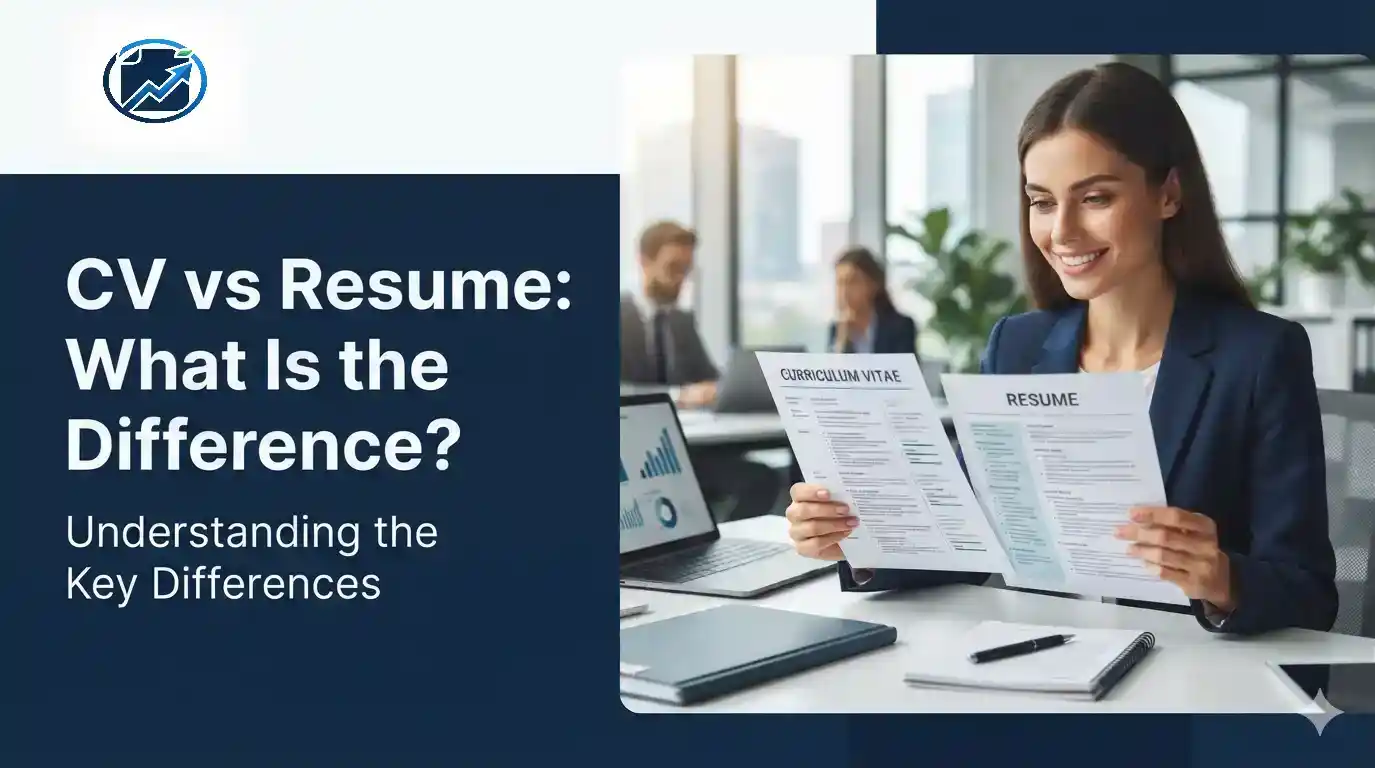
The main difference between a CV and resume is their length, purpose, and level of detail.
A CV provides a detailed record of your academic and professional background. A resume is a shorter, targeted document that highlights your most relevant qualifications for a particular job.
Here is a simple comparison:
| Comparison | CV | Resume |
|---|---|---|
| Full form | Curriculum Vitae | Resume has no expanded full form |
| Length | Often 2 or more pages; varies by purpose | Usually 1–2 pages |
| Purpose | Detailed academic or professional history | Highlights suitability for a specific job |
| Content | Comprehensive | Selective and relevant |
| Focus | Education, experience, research, achievements | Relevant skills, experience, and achievements |
| Customization | Often updated as your career develops | Usually tailored for each job |
| Common use | Academic, research, and general job applications in many countries | General job applications, especially in the USA and Canada |
| Publications | Often included when relevant | Usually omitted unless relevant |
| Best for | Academic and research professionals, and countries requesting a CV | Applicants targeting specific jobs where a resume is expected |
Important: The terms CV and resume are not used in exactly the same way around the world. In countries such as Bangladesh, South Africa, the UAE, and the UK, a CV is commonly requested for ordinary job applications. In the USA and Canada, a resume is generally preferred for most non-academic jobs.
Always check the employer’s instructions before submitting your document.
CV vs Resume: Key Differences Explained
The comparison table gives you a quick overview. Let’s look at the most important differences in more detail.
1. Difference in Length
A CV is generally longer because it provides a detailed record of your academic and professional background.
For example, an experienced researcher may have a five-page CV listing their degrees, research projects, publications, conference presentations, and teaching experience.
A resume is usually shorter. It focuses on the qualifications that matter most for a particular position.
For example, someone applying for a marketing assistant job may only need a one-page resume highlighting relevant education, digital marketing skills, and practical experience.
2. Difference in Purpose
A CV is commonly used to present your complete academic or professional background. It is especially useful for academic, research, teaching, and medical applications.
A resume is designed to help employers quickly understand why you are suitable for a specific position.
For example:
- Applying for a university research position? A detailed CV may be appropriate.
- Applying for a sales assistant position in Canada? A targeted resume is generally expected.
- Applying for a teaching job in Bangladesh? A CV is commonly requested.
3. Difference in Content
A CV can contain more detailed information about your career and education.
It may include:
- Academic qualifications
- Research experience
- Publications
- Teaching experience
- Professional memberships
- Awards and scholarships
- Work history
A resume usually focuses on:
- Relevant work experience
- Job-related skills
- Education
- Professional achievements
- Selected certifications
The goal of a resume is to avoid unnecessary information and make your strongest qualifications easy to find.
4. Difference in Customization
A CV is often maintained as a comprehensive document. You can update it when you gain new qualifications, experience, or achievements.
A resume is normally customized for each job application.
For example, if you apply for both an administrative assistant position and a digital marketing position, you should emphasize different skills in each resume.
For an administrative role, highlight organization, communication, and computer skills.
For a digital marketing role, highlight SEO, social media management, content writing, and analytics.
5. Difference in Format
Both documents should use a professional and easy-to-read format.
However, a CV may contain more sections because it covers a wider range of information.
A resume should generally use a simple layout with clear headings, concise bullet points, and relevant achievements.
For both documents, use readable fonts, consistent formatting, and clear section titles. Avoid unnecessary graphics, excessive colors, and complicated layouts that may make the document difficult to read.
CV vs Resume With Example: What Do They Look Like?
Understanding the difference is easier when you compare real examples.
Let’s consider two applicants applying for different positions.
Example 1: CV for an Academic Position
Applicant: Sarah Ahmed
Position: University Lecturer
Professional Profile: Business graduate with academic research interests and teaching experience.
Education:
- Master of Business Administration, 2024
- Bachelor of Business Administration, 2022
Teaching Experience:
- Teaching Assistant, ABC University
- Assisted with classroom activities and student assignments.
Research Experience:
- Completed a research project on employee motivation.
- Presented findings at a university seminar.
Publications:
- Research article on workplace motivation.
Skills:
- Academic writing
- Research and analysis
- Teaching and presentation
- Communication
This CV provides a detailed overview of Sarah’s academic background and experience. It is suitable for an academic application.
Example 2: Resume for a Marketing Assistant Position
Applicant: John Smith
Position: Marketing Assistant
Professional Summary: Motivated marketing graduate with knowledge of SEO, social media, and content creation.
Education:
- Bachelor of Marketing, 2025
Relevant Experience:
- Completed a university digital marketing project.
- Created sample social media campaigns.
- Conducted basic keyword research for a student project.
Skills:
- SEO basics
- Social media marketing
- Content writing
- Microsoft Excel
- Communication
This resume focuses on the qualifications relevant to the marketing assistant position. It does not include unrelated academic details.
What is the main lesson?
A CV presents a broader picture of your background, while a resume highlights the information most relevant to a particular job. The right document depends on the employer’s expectations and the type of position.
CV vs Resume: Which Is Better?
Neither a CV nor a resume is always better. The right choice depends on the country, job type, industry, and employer’s requirements.
Both documents can help you get an interview when they are written clearly and contain relevant information.
Here is how to choose:
When Should You Use a CV?
Use a CV when:
- The employer specifically requests a CV.
- You are applying for an academic or university position.
- You are applying for a research or teaching role.
- You need to present detailed academic qualifications and publications.
- You are applying for a job in a country where CV is the standard term.
For example, a lecturer applying to a university in Bangladesh would typically prepare a CV showing education, teaching experience, research, and publications.
When Should You Use a Resume?
Use a resume when:
- You are applying for a non-academic job in the USA.
- You are applying for most professional jobs in Canada.
- The employer specifically requests a resume.
- You want to highlight skills and experience for a particular position.
- The application instructions specify a short, targeted document.
For example, someone applying for a software developer position in Canada would normally prepare a targeted resume featuring programming skills, projects, and relevant employment experience.
Which Is Better for Fresh Graduates?
If you are a fresh graduate with little or no work experience, both formats can work.
Your choice should depend on the country and the employer’s instructions.
A fresher’s CV or resume can include:
- Educational qualifications
- Academic projects
- Internships
- Volunteer activities
- Online courses
- Technical skills
- Certifications
- Extracurricular achievements
For example, a recent computer science graduate applying for a junior developer position can highlight programming languages, university projects, and personal coding projects.
You do not need years of employment history to create a strong application document.
CV vs Resume: Differences in Different Countries
The terminology can be confusing when applying for international jobs. Some countries use CV and resume differently, while others use the terms interchangeably.
Here is a general guide.
1. CV vs Resume in the USA
In the United States, a resume is commonly used for most non-academic job applications.
A CV is generally used for academic, scientific, medical, and research positions.
If you are applying for a regular office, sales, IT, or marketing position, prepare a resume unless the employer requests something else.
2. CV vs Resume in Canada
In Canada, the term resume is commonly used for general job applications.
A CV is generally used for academic, research, and certain specialized professional positions.
If you are applying for a retail, customer service, administrative, or entry-level position, a targeted resume is usually the appropriate choice.
3. CV vs Resume in the UK
In the United Kingdom, CV is the standard term for most job applications.
Employers generally expect a concise document highlighting relevant qualifications, skills, and work experience.
A typical UK job CV is often around two pages, although the appropriate length depends on your experience and the position.
4. CV vs Resume in Bangladesh
In Bangladesh, CV is widely used for both private and public-sector job applications.
Employers commonly ask candidates to submit a CV containing personal details, education, experience, skills, and references when required.
Fresh graduates should highlight academic achievements, internships, projects, and relevant training.
5. CV vs Resume in South Africa
In South Africa, CV is the commonly used term for job application documents.
Employers generally expect information about education, work experience, skills, and relevant qualifications.
Always follow the vacancy advertisement and provide the information requested by the employer.
6. CV vs Resume in the UAE
In the UAE, CV is widely used for general job applications.
Employers may request a CV containing professional experience, education, skills, and contact information.
If you are applying for an international company, check whether the vacancy specifically requests a CV or resume and follow its instructions.
Remember: These are general conventions, not strict rules for every employer. International companies may use different terminology.
How to Write a Good CV or Resume
Whether you prepare a CV or a resume, your document should be clear, professional, and easy to understand.
Follow these practical tips:
1. Use a Professional Format
Choose a simple layout with clear headings and consistent spacing. Avoid unnecessary designs that make your document difficult to read.
2. Write a Strong Professional Summary
Start with two or three sentences explaining your background, strongest skills, and career goals.
For example:
“Recent business administration graduate with strong communication, organizational, and computer skills. Interested in an entry-level administrative position where I can apply my knowledge and develop professional experience.”
3. Highlight Relevant Skills
Include skills that match the job advertisement.
Examples include:
- Communication
- Teamwork
- Problem-solving
- Microsoft Office
- Customer service
- Project management
- Computer skills
- Time management
Do not simply list skills. Where possible, provide examples of how you have used them.
4. Include Measurable Achievements
If possible, explain what you achieved rather than only listing your responsibilities.
For example:
Instead of: “Responsible for social media.”
Write: “Created and scheduled social media content for a university project.”
Use accurate figures only when you can support them.
5. Avoid Spelling and Grammar Mistakes
Read your document carefully before submitting it. Check your contact details, job titles, dates, and company names.
6. Customize Your Document for Each Job
Read the job description and identify the most important requirements.
Highlight your relevant qualifications and achievements. Do not send the same unchanged resume for every job.
7. Save Your Document in the Requested Format
PDF is commonly accepted because it helps preserve formatting. However, some employers request a Word document or an online application form.
Always follow the employer’s instructions.
Common Mistakes to Avoid When Writing a CV or Resume
Even qualified candidates can weaken their applications by making simple mistakes.
Avoid these common problems:
1. Using the Same Document for Every Job
Different jobs require different skills. Customize your resume or select relevant information in your CV for each application.
2. Including Unnecessary Personal Information
Do not automatically include sensitive personal details. Requirements vary by country and employer. Follow local application guidance.
3. Writing Too Much Information
Include relevant details instead of adding unrelated experiences or lengthy descriptions.
4. Using an Unprofessional Email Address
Use a simple email address based on your name. Avoid nicknames or informal words.
5. Adding False Information
Never invent qualifications, work experience, certificates, or achievements. Employers may verify the information.
6. Ignoring the Job Description
Your document should show how your skills and qualifications match the advertised position.
Frequently Asked Questions (FAQs)
1. What is the difference between CV and resume with example?
A CV is generally a detailed document covering your academic and professional background. A resume is a shorter document highlighting qualifications relevant to a specific job. For example, a university lecturer may use a CV with research and publications, while a marketing assistant may use a resume focused on marketing skills and experience.
2. Is a CV better than a resume?
Neither is always better. A CV is suitable when employers request detailed academic or professional information. A resume is generally better for targeted job applications in countries such as the USA and Canada. Always follow the employer’s instructions.
3. Can I use a CV instead of a resume?
Sometimes. In countries where CV is the standard term, it is commonly accepted for general job applications. However, if an employer specifically requests a resume, prepare a resume that follows their requirements.
4. What is the difference between a CV and a resume for fresh graduates?
A fresh graduate’s CV may include detailed education, academic achievements, projects, training, and internships. A graduate’s resume focuses on the most relevant qualifications and skills for a particular job. Both can be useful when applying for entry-level positions.
5. How many pages should a CV or resume be?
A resume is usually one or two pages long. A CV can be two or more pages, depending on your qualifications, experience, and purpose. Academic CVs can be longer because they may include publications, research, and teaching experience.
6. Do employers prefer CV or resume?
It depends on the country, industry, and job. Employers in the USA and Canada generally request resumes for non-academic jobs, while employers in Bangladesh, South Africa, the UK, and UAE commonly request CVs. Always check the job advertisement.
7. Is a CV the same as a resume in the UK?
In the UK, CV is the standard term for the document used in most job applications. It generally contains relevant work experience, education, skills, and achievements. It is not usually necessary to prepare a separate resume for ordinary UK job applications.
8. Should I include a photo in my CV or resume?
It depends on the country, industry, and employer’s requirements. Photos are generally not expected on standard resumes in the USA and Canada. In other markets, practices can vary. Check local guidance and the job advertisement before including a photograph.
Final Thoughts: Choose the Right Document for Your Job Application
Understanding the difference between CV and resume can make your job search easier. Although both documents present your qualifications, they serve slightly different purposes.
A CV is generally more detailed and is commonly used for academic applications and general job applications in many countries. A resume is usually shorter and focuses on the skills and experience most relevant to a particular position.
If you are applying for jobs internationally, do not assume that every country uses these terms in the same way. Check the vacancy requirements before preparing your document.
Whether you choose a CV or resume, keep it professional, highlight your strengths, and provide accurate information.
Looking for your next career opportunity? Visit New Jobs Circular to explore job opportunities, career advice, and useful application tips for job seekers.
About the Author